
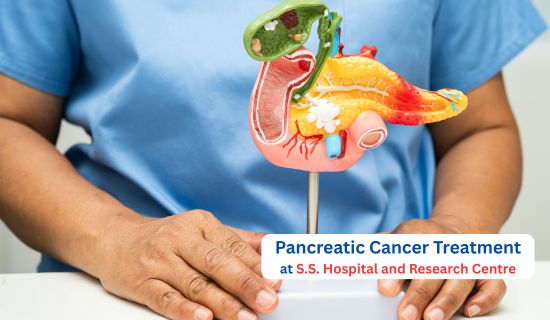
Pancreatic Cancer Treatment Options available at S S Hospital
Pancreatic cancer refers to cancer that originates in the tissues of the pancreas, an organ located behind the stomach that is responsible for producing digestive enzymes and hormones such as insulin. Pancreatic cancer is often diagnosed in later stages because the symptoms are subtle and can easily be mistaken for other conditions. This type of cancer is known for its aggressive nature and poor survival rate, making early detection and treatment crucial.
Pancreatic cancer is a challenging disease that requires a personalized approach to treatment, depending on the cancer's stage, location, and whether it has spread.
The treatment plan often involves a combination of surgery, chemotherapy, radiation, targeted therapies, and palliative care to manage symptoms and improve quality of life. Below are the primary treatment options available for pancreatic cancer:
Surgery for Pancreatic Cancer
Surgery is the most effective treatment option for pancreatic cancer if the tumor is localized (confined to the pancreas) and can be removed. The specific surgical procedure depends on the tumour’s location within the pancreas.
Whipple Procedure (Pancreaticoduodenectomy)
This is the most common surgery for tumors located in the head of the pancreas. During the Whipple procedure, the surgeon removes the head of the pancreas, part of the small intestine, bile duct, gallbladder, and sometimes nearby lymph nodes. This is a complex and major surgery that requires careful post-operative care.
Distal Pancreatectomy
If the tumor is located in the body or tail of the pancreas, the surgeon may remove part or all of the pancreas, and sometimes the spleen. This surgery is less extensive than the Whipple procedure but is still significant.
Total Pancreatectomy
In rare cases, when the tumor affects the entire pancreas, a total pancreatectomy may be performed. This involves removing the entire pancreas, along with the spleen, parts of the stomach, and small intestine.
Chemotherapy for Pancreatic Cancer
Chemotherapy is often used in combination with surgery, as a primary treatment for advanced cancer, or as palliative care to manage symptoms. Chemotherapy drugs are used to kill cancer cells, slow tumor growth, and shrink tumors to make surgery more effective.
Adjuvant Chemotherapy
After surgery, chemotherapy may be used to kill any remaining cancer cells that could not be removed, reducing the risk of recurrence.
Neoadjuvant Chemotherapy
This approach uses chemotherapy before surgery to shrink the tumor, making it easier to remove.
Palliative Chemotherapy
In cases of advanced pancreatic cancer, chemotherapy may help alleviate symptoms, extend survival, and improve quality of life.
Radiation Therapy (In Collaboration with)
Radiation therapy uses high-energy rays to destroy cancer cells. It is typically used in combination with chemotherapy for pancreatic cancer, especially in advanced cases.
- External beam radiation (radiation that comes from outside the body): This is the most common form of radiation therapy, where beams of radiation are directed from outside the body to the tumor site. It is often used for pancreatic cancer incombination with chemotherapy to shrink the tumor before surgery or to reduce symptoms in advanced stages.
- Radiation placed inside the body (brachytherapy): This advanced technique delivers high doses of radiation to the tumour with great precision, minimizing damage to surrounding healthy tissues. Radiation therapy is often used when the cancer cannot be surgically removed or when symptoms need to be managed.
Targeted Therapy
Targeted therapy involves drugs or other substances that specifically target cancer cells without affecting normal cells. This treatment aims to block the growth and spread of cancer by targeting the molecular changes that cause pancreatic cancer cells to grow.
For pancreatic cancer, targeted therapies are often still in experimental stages, but promising options are being studied. Some drugs focus on proteins and pathways that are essential for the growth of cancer cells.
Immunotherapy
Immunotherapy is a treatment that uses the body's immune system to fight cancer. While it is still being studied for pancreatic cancer, there have been some promising developments.
Checkpoint Inhibitors
These drugs block certain proteins that prevent immune cells from attacking cancer cells. While immunotherapy is not yet a standard treatment for pancreatic cancer, it is being investigated in clinical trials for patients with certain genetic mutations or those with metastatic pancreatic cancer.
Vaccines
Cancer vaccines are designed to stimulate the immune system to recognize and destroy cancer cells. Research is ongoing to develop vaccines for pancreatic cancer, though they are not yet widely available.
Palliative Care :
At SS Hospital we focuses on improving quality of life during and after cancer treatment.
Services to Mention:
- Pain and symptom management
- Nutrition and counseling support
- End-of-life care
- Psychological and emotional support for patients and families